
Knee Replacement
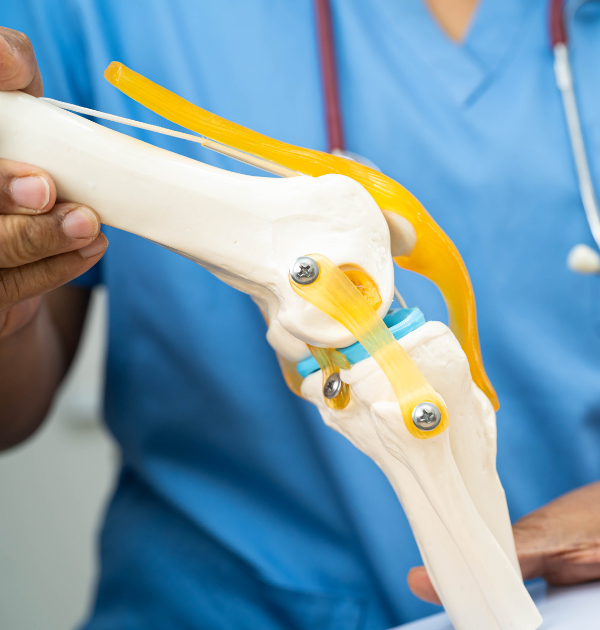
Knee Replacement Surgery · Faridabad
Regain Pain-Free Movement with Advanced Knee Replacement Solutions
Persistent knee pain can make even simple activities like walking, climbing stairs, or standing for long periods difficult. When medications, physiotherapy, injections, and lifestyle changes no longer provide lasting relief, knee replacement surgery may be the most effective solution to restore mobility and improve quality of life.
Dr. Amit Sharma specializes in comprehensive knee replacement care, helping patients choose the most appropriate treatment based on the severity of arthritis, the extent of joint damage, age, activity level, and overall health. Whether you require a Total Knee Replacement or a Partial Knee Replacement, every treatment plan is designed to maximize function while preserving as much of your natural knee as possible.
What is Knee Replacement Surgery?
Knee replacement surgery is an orthopaedic procedure in which damaged cartilage and worn-out joint surfaces are replaced with specially designed artificial implants. The objective is to relieve chronic pain, restore joint alignment, improve stability, and allow patients to return to everyday activities with greater comfort.
Modern implants are engineered to closely replicate the natural movement of the knee, providing long-lasting function and improved mobility.
Depending on the condition of the joint, only the damaged portion of the knee may need replacement, or the entire joint may require reconstruction.

When is Knee Replacement Recommended?
Many patients live with knee pain for years before seeking specialist care. While early arthritis can often be managed without surgery, advanced joint degeneration eventually reaches a stage where conservative treatment becomes ineffective.
You may benefit from knee replacement surgery if you experience:
- Persistent knee pain despite medication and physiotherapy
- Difficulty walking or climbing stairs
- Pain during routine daily activities
- Severe morning stiffness
- Swelling that repeatedly returns
- Bow-leg or knock-knee deformity
- Night pain that disturbs sleep
- Reduced ability to work or remain physically active
Patients commonly require knee replacement because of:
- Advanced Osteoarthritis
- Rheumatoid Arthritis
- Post-traumatic Arthritis
- Severe Cartilage Damage
- Joint Deformity
Types of Knee Replacement Surgery
Not every patient requires the same procedure
The choice depends on how much of the knee has been affected by arthritis and whether healthy portions of the joint can be preserved.
Total Knee Replacement (TKR)
Total Knee Replacement is recommended when arthritis has affected most or all compartments of the knee.
During the procedure, the damaged joint surfaces are replaced with artificial components that recreate smooth joint movement and restore alignment.
It is generally recommended for patients with:
- Advanced osteoarthritis
- Extensive cartilage loss
- Significant joint deformity
- Severe pain affecting daily life
Patients undergoing Total Knee Replacement often experience substantial pain relief, improved walking ability, and better overall function after rehabilitation.
Partial Knee Replacement (Unicompartmental Knee Replacement / UKR)
Partial Knee Replacement is suitable when arthritis is confined to only one compartment of the knee while the remaining structures remain healthy.
Instead of replacing the entire joint, only the damaged section is resurfaced.
Potential advantages include:
- Smaller surgical incision
- Preservation of healthy bone
- More natural knee movement
- Less blood loss
- Faster recovery
- Shorter hospital stay
Not every patient is a candidate for this procedure, making careful evaluation essential.
Total vs Partial Knee Replacement
| Feature | Total Knee Replacement | Partial Knee Replacement |
|---|---|---|
| Portion of Knee Replaced | Entire joint | Only damaged compartment |
| Suitable For | Advanced arthritis | Localized arthritis |
| Bone Preservation | Less | More |
| Recovery | Standard | Often quicker |
| Knee Feel | Excellent function | More natural movement |
| Surgical Complexity | Comprehensive reconstruction | Targeted procedure |
The most appropriate procedure depends entirely on your knee condition rather than personal preference.

Which Knee Replacement is Right for You?
Choosing between Total and Partial Knee Replacement requires careful evaluation rather than a one-size-fits-all approach.
During consultation, Dr. Amit Sharma assesses several important factors, including:
- X-ray findings
- MRI (when necessary)
- Extent of cartilage damage
- Ligament integrity
- Knee alignment
- Age
- Activity level
- Lifestyle expectations
- Medical history
Only after a comprehensive assessment is the most suitable procedure recommended.
The primary goal is always to perform the least invasive procedure that will provide durable, long-term relief.
Our Approach to Knee Replacement Care
Successful knee replacement begins long before the operation and continues well after surgery.
01
Comprehensive Evaluation
A detailed consultation includes medical history, physical examination, imaging studies, and assessment of overall health.
02
Accurate Diagnosis
The exact cause of pain is identified to ensure surgery is truly indicated and appropriate.
03
Personalized Treatment Planning
Based on the condition of the knee, patients receive individualized recommendations regarding:
- Total Knee Replacement
- Partial Knee Replacement
- Non-surgical alternatives (where appropriate)
04
Advanced Surgical Care
Every procedure is performed using evidence-based surgical techniques with careful attention to precision, alignment, soft tissue balancing, and implant positioning.
05
Rehabilitation and Recovery
Recovery includes:
- Early mobilization
- Guided physiotherapy
- Pain management
- Walking training
- Strengthening exercises
- Regular follow-up assessments
The objective is a safe recovery and long-term joint function.
Benefits of Knee Replacement Surgery
Patients who undergo appropriately indicated knee replacement often experience:
Significant pain relief
Improved walking ability
Better joint stability
Increased range of motion
Improved quality of life
Greater independence
Better sleep due to reduced pain
Ability to return to many daily activities
Why Choose Dr. Amit Sharma for Knee Replacement Surgery in Faridabad?
Choosing the right orthopaedic surgeon is one of the most important decisions in your treatment journey.
Dr. Amit Sharma provides patient-centred care focused on accurate diagnosis, transparent communication, and evidence-based treatment planning.
Patients benefit from:
- Comprehensive orthopaedic evaluation
- Personalized treatment recommendations
- Expertise in primary knee replacement procedures
- Focus on preserving healthy joint structures whenever possible
- Modern surgical techniques
- Structured rehabilitation guidance
- Long-term follow-up care
- Compassionate, ethical, and patient-focused treatment
Every recommendation is based on clinical findings, ensuring that surgery is advised only when it offers meaningful long-term benefit.
Looking for guidance?
Common questions answered
Is knee replacement my only option?
No. Many patients improve with physiotherapy, medications, weight management, injections, or activity modification. Surgery is considered when these treatments no longer provide adequate relief.
How do I know whether I need Total or Partial Knee Replacement?
The decision depends on the extent of arthritis, joint alignment, ligament condition, and imaging findings. A specialist evaluation determines the most suitable option.
How long does recovery take?
Most patients begin walking shortly after surgery with assistance. Functional recovery continues over several weeks, while full improvement may take several months depending on rehabilitation and individual health.
Will I be able to walk normally again?
Most patients experience significant improvement in walking ability, reduced pain, and greater independence following successful surgery and rehabilitation.
How long do knee implants last?
Modern knee implants are designed for long-term durability. Longevity depends on factors such as activity level, body weight, implant type, and overall health.
Can both knees be replaced?
Yes. Depending on your overall health and medical assessment, knee replacement may be performed on both knees either during the same hospitalization or as staged procedures.